Paintings
Artist Statement
Works on the theme of 〈 Human and Machine 〉, exploring personality, emotion, and the interaction between society and machines.
This body of work is an attempt to ask again “what is a human being?” under contemporary conditions in which the boundary between human and machine is wavering. Beginning with the structural imbalance of society around neurodiversity (01), the inquiry deepens step by step: to the transformation of humanity through over-adaptation to society (02), to the fluid structure of self, memory and personality (03), and finally to the end of the anthropocentric framework (04). This deepening is not a mere change of subject; it is a spiral development in which the same question is asked again and again at different layers.
The materials and techniques used in the work are not simply tools for speaking about this question; they function as the material implementation of the thought itself. In both the process of making and the process of viewing, the material phenomena themselves directly embody “the boundary between human and machine.”
Key Phrases
A key phrase is set every two years as a guide for the work.
01. 2020-2021: 〈 Machine-Humans Mimicking Humans 〉
On the relationship between neurotypical and neurodivergent people.
In contemporary society, the neurological minority is marginalized within a dominant culture shaped by the neurological majority, and is placed in conditions where adequate social adaptation is difficult.
For this reason, many in the minority try to overcome their social handicap by concealing their own traits and imitating the behavior, language and emotional expression of the majority. Adaptation through such mimicry greatly increases the mental burden on the person and raises the risk of secondary disorders.
Yet the cause of these difficulties lies not with the individual but with a social structure built on particular neurological traits as the norm. Because neurological diversity concerns the very essence of personality, a society in which one can live only by unilaterally suppressing it is plainly discriminatory and harbors an inhumane structure.
This process — maintaining a constant gap between inner state and outer expression in order to fit external norms — corresponds structurally to the way an algorithm operates, optimizing its output according to a given specification. 〈 Machine-humans mimicking humans 〉, then, are people who keep overwriting their own particularity with the logic of external norms, and in that sense they take on the character of a form of machine.
Focusing on this structure, in which humans are forced to behave mechanically in order to be human, the work makes visible the imbalance of contemporary society around neurodiversity and explores through making the fundamental question “what is humanity?” This question will be asked again, in different forms, in the periods that follow.
The work also starts from the artist’s own experience as a person with attention-deficit/hyperactivity disorder; it is at once a critical examination of social structure and a practical inquiry from the position of someone directly concerned.
02. 2022-2023: 〈 Humanity Being Lost 〉
On the relationship between 〈 mechanizing humans 〉, who show over-adaptation to social structure, and 〈 humanizing machines 〉, brought about by the progress of science and technology.
The structure of mimicry questioned in the previous period is not a problem unique to the neurological minority. The growing complexity of social structure, which began with large-scale settled societies, has accelerated since the Industrial Revolution, and humans have increasingly oriented themselves toward rationalization, regulation and calculability. This is learned adaptation — a survival strategy for living through a society that has become complex.
When humans are compared with machines, their characteristics clearly differ. Put simply, the characteristic of humans lies in contingency, and that of machines in planning. Contingency here means the unpredictable, emergent phenomena that arise as the inside of a subject and the outside world constantly exchange information. The planning of machines, by contrast, is the calculability of executing an optimal solution within the range of a designed specification.
In this contrast, humans who lose their contingency through over-adaptation to a highly complex social structure are called 〈 mechanizing humans 〉, and machines that try to acquire human characteristics through the progress of science and technology are called 〈 humanizing machines 〉. In a situation where the two approach each other, the work makes visible the structure of 〈 humanity being lost 〉 and explores, through making, the relationship between 〈 mechanizing humans 〉 and 〈 humanizing machines 〉.
03. 2024-2025: 〈 The Fluidity of Humans 〉
On the fluid aspects of humans, and on memory, personality and self-consciousness as things that are reconstructed.
Until the previous period the question was directed at “the relationship between humans and society.” In this period the viewpoint turns to “the structure of the human itself,” in order to take on the question “what is humanity?”
Life is not a static system but a dynamic system that maintains order through the exchange of information. Through metabolism, the molecules that make up an individual are replaced in regular cycles, yet the structure as a whole remains stable. Life, therefore, should be understood not as a fixed, mechanical structure but as a fluid order that persists within a flow of information.
This framework can also be applied to mental phenomena. Memory is not stored in fixed form; it is a reconstructive process in which neural circuits are reorganized each time we recall. Personality is not an unchanging psychological trait but a variable structure that shifts with social context. In this way, mental phenomena such as memory and personality are also dynamic phenomena reconstructed within a flow of information.
From this perspective, self-consciousness can be understood not as a constant entity but as an information structure formed temporarily through physical interactions. 〈 The fluidity of humans 〉 is the dynamic, generative process observed when self-consciousness is grasped as an information process, and the exploration and visualization of this structure is the aim of the work in this period.
04. 2026-2027: 〈 The End of the Human Era 〉
On the leveling of human value, an instant view of life, and the dispersing human species.
The “structure of the human” questioned in the previous periods develops in this period onto a larger scale.
Human cognition and emotion are formed on the basis of interactions between the electrical oscillation and chemical transmission of neural signals. External stimuli are converted into electrical signals through receptors and processed in the central nervous system. At this point the rhythms of the nervous system resonate with the periodic structures inherent in external stimuli such as music, form and language, forming the basis of cognitive judgment and emotional response. In this respect, human mental activity can be understood as a resonance between the structural rhythms of the outside world and the rhythms of the nervous system.
The interaction of information in social information networks also shows patterns of repetition, synchronization and diffusion, just like signal transmission in neural circuits. There is a structural similarity between the rhythms of the nervous system and the dynamics of social information networks, so that human society as a whole can be regarded as a macroscopic nervous system.
At every level of the information structure the same optimization principle — the minimization of prediction error — is at work, and the order of a higher level is generated as the emergent result of interactions at the lower level. In this way, the fluidity of information that runs through humans, society and the universe can be understood as a hierarchical, self-similar structure.
From this viewpoint, “the human” is no longer confined to an organic body; it exists as a pattern of oscillating information. Indeed, through the progress of science and technology, the value of human beings and the meaning of life have lost a single center and are spreading out into diverse forms. If an age arrives in which life is copied, edited and extended, humans will no longer be able to claim a privileged ontological status as self-evident.
The artist calls this turning point in the form of existence 〈 the End of the Human Era 〉. It does not mean the extinction of humankind; it means the end of the anthropocentric framework.
In this period, the work visualizes this “wave-like structure of existence” through the accumulation and rhythmic repetition of lines drawn with a fineliner pen, and presents a new image of the human in 〈 the End of the Human Era 〉 — the human as a distributed, resonant being.
Materials and Techniques
The materials used in this work are fineliner pens, gold pens and gold paint. Moiré patterns created by drawn lines are also used extensively as a technique. These are not auxiliary means for making thoughts or concepts visible. The irreversibility of the drawn line, the accumulation of error, the variation of perception depending on viewing conditions, and the emergence of order through interference between layers present — as material phenomena, in both the making and the viewing — the process by which orders of information such as self, society and value are dynamically generated, maintained and updated.
01. The Drawn Line as an Irreversible Trace
A fineliner pen is a drawing device premised on a constant line width and ink supply; once a line is drawn, it cannot be erased or corrected.
This irreversibility is not a merely metaphorical symbol but a physical property that imposes strong constraints on the process of making itself. In this work the fineliner pen functions not as “a tool for expression” but as an environmental condition that forces the generation of irreversible traces.
In that the intentions, movements and judgments of the artist are fixed on the picture in irreversible form, the drawn line corresponds structurally to the process by which a living system that minimizes prediction error accumulates its past history of actions as an internal state.
What matters is that the irreversibility of the line constrains not the decision of a finished image but the chain of local choices of action. The artist has no choice but to select the next line on the premise of the lines already drawn, and the drawing process is always one of adjusting the prediction error between an existing generative model (the distribution of lines on the picture) and a new action.
As a result, the order that appears on the picture is not a composition fully planned in advance but a metastable state that emerges from local optimization repeated under irreversible constraints. Drawing with a fineliner pen is therefore an experimental system that materially implements the process by which a free-energy-minimizing system searches, within environmental constraints, for a temporary point of stability.
02. The Wavering Line as the Surfacing of Prediction Error
The fineliner pen is a tool designed to produce uniform, stable lines. But because its use ultimately depends on the movement of a human body, it cannot completely eliminate errors such as slight trembling, changes in pressure and changes in speed.
In this work, such wavering is kept deliberately — not as “noise to be eliminated” but as a trace in which the gap between intention and result has surfaced as material. The error remains on the picture and is built into the subsequent drawing process as a new constraint. Drawing becomes not “an act of erasing error” but a process of continually updating a state that contains error.
The wavering of the line shows, at the level of matter, that the artist is a being who keeps maintaining order while carrying error, never reaching perfect prediction. In this way the picture is built not from perfectly controlled lines but from the accumulation of lines that contain wavering.
03. The Observation-Dependence and Sacredness of Gold
Because of the metal particles contained in the pigment, gold drawing materials change their reflective properties according to the incident light and the angle of observation. Even on the same picture, the perceived hue and brightness vary with the viewer’s position and the conditions of light.
This material property makes gold function not as a merely symbolic color but as an information structure that behaves inseparably from the act of observation. As the viewpoint moves, the picture shows different faces, betraying the viewer’s predictions and repeatedly giving rise to perceptual error.
Through this perceptual uncertainty, the picture refuses to be grasped as a fixed image, and the relationship between viewer and work shifts to a dynamic one. The act of viewing itself is experienced as a continuous process of prediction and correction.
The work at this point is not a completed image but an event generated as a different metastable state each time it is viewed. The “sacredness” that gold has carried in religious art since ancient times was less a representation of a transcendent entity than a device suggesting the existence of a structure beyond human perception and understanding. This work reinterprets that function materially: gold is placed within the picture as a phenomenon in which orders of information at different levels intervene at the level of perception.
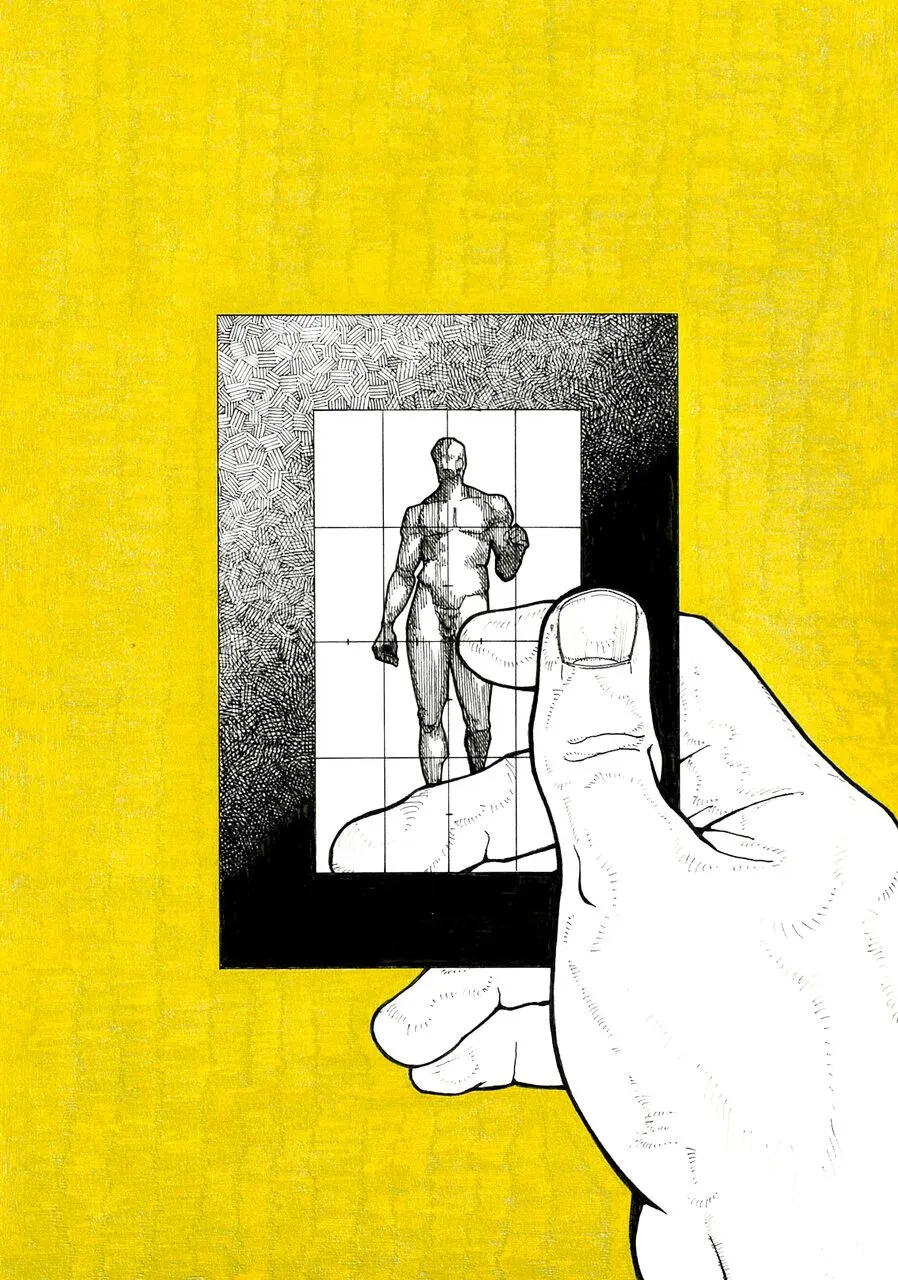
Observation
2026
The yellow areas are gold. A scan records the reflection of the gold from a single angle only.
04. The Moiré Pattern as Higher-Order Order
Moiré is the phenomenon in which, when several periodic structures are superimposed, a new periodic pattern is perceived that did not exist in any of the individual structures. In this work, regular structures such as grids and repeated lines are deliberately overlaid to generate this phenomenon on a two-dimensional plane.
Each line or grid is an order that is locally consistent. Yet when they overlap, a pattern appears that existed in none of them alone. The artist cannot design this appearance. What can be designed is only the conditions for its appearance.
This process corresponds structurally to the emergence of order through interference between levels, observed from signal processing within neural hierarchies, to the dynamics of social information networks, and on to still larger cosmological scales. In this way, the moiré pattern in this work shows directly and materially, on a two-dimensional plane, that an order which cannot be explained as the simple sum of lower orders arises as the result of interaction.
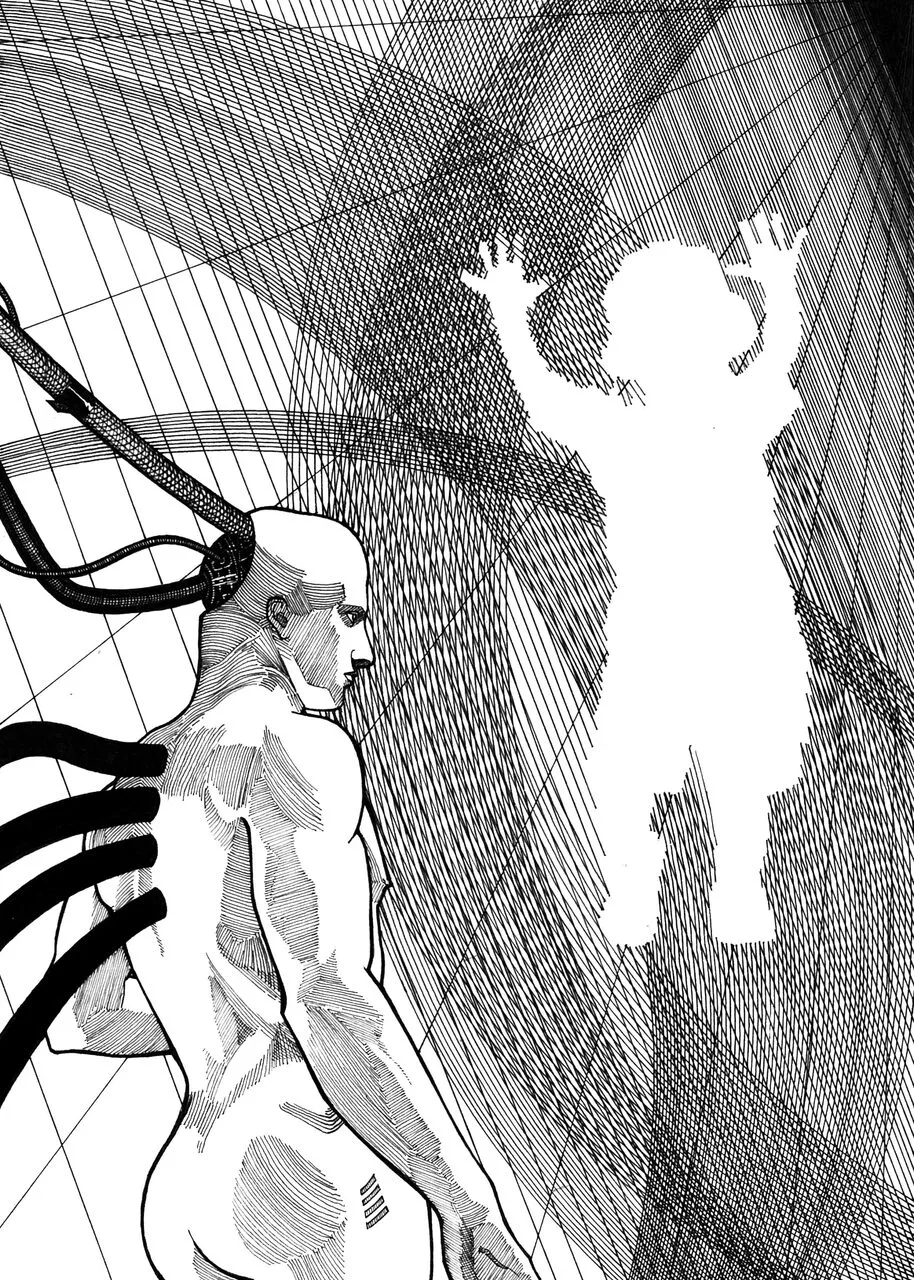
Specification
2026
Bands that no single line contains emerge where the repeated lines overlap.