Photographs
Artist Statement
Works on the theme of 〈 Continuity 〉, exploring the continuity of matter and spacetime, of life and the city.
The question of “the boundary between human and machine” pursued in the paintings can also be called a question of “continuity.” If no clear-cut boundary can be drawn between human and machine, it is because both are situated within a continuous flow of information. The photographs explore this continuity from different dimensions — matter, spacetime and the city — as a practice that runs alongside the paintings.
Whereas painting materially implements the process by which order is generated through the accumulation of drawn lines, photography cuts out and fixes a single section of a continuous world through the act of observation. Yet that section, too, keeps changing within the flow of time. Taking a photograph is an act of leaving a trace upon a continuous world, and in that sense it practices the same principle of making as painting, through a different medium.
The work develops its exploration of “continuity” step by step: from the dynamic equilibrium of matter (01), to the beauty of sections of spacetime (02), to the geometric order of the city (03). This development is not a change of subject but a spiral deepening, in which the same question is asked again and again at the different scales of matter, spacetime and the city.
Key Phrases
A key phrase is set every two years as a guide for the work.
01. 2022-2023: 〈 Dynamic Equilibrium 〉
Capturing the beauty of dynamic equilibrium within a flow of particles.
Seen physically, all matter is a collection of particles, and the distinction between solid and fluid is relative once the time scale changes. Corroding metal and decaying wood are solids, yet over the long term they can be regarded as fluids. Matter, in other words, is not a fixed entity but exists as a temporarily stable state within a flow of particles.
Life, too, is within this continuity. Life keeps a temporary balance through the difference in speed between breakdown and reconstruction. When breakdown overtakes reconstruction, life meets death, but its components become the material of other lives. The boundary of an individual appears clear, yet as a flow of matter it continues without interruption.
Such states of dynamic equilibrium take forms of order that are hard to predict within our everyday perceptual framework. Patterns of corrosion, the scattering of light, the traces of flow — these are experienced not as the beauty of fixed forms but as beauty that has temporarily appeared within a process. Their beauty shows to the senses that the world is not a still image but an order of information that keeps flowing.
In this period the work focuses on such fluid aspects of matter and explores through photography the beauty that states of dynamic equilibrium bring to light. In the next period this exploration expands to a larger scale: the continuity of spacetime itself.
02. 2024-2025: 〈 The Flow of Spacetime 〉
Capturing the beauty of the subject as the beauty of a section of spacetime.
The continuity questioned at the level of matter in the previous period is extended in this period into the dimension of spacetime.
A beautiful form can be understood as a higher-order structure made manifest under particular conditions of observation. Beauty, in other words, is not a fixed attribute but the appearance of an order that holds temporarily in relation to the act of observation. From this viewpoint, photographing is understood not as an act of recording the beauty of the world but as a process in which the act of observation itself generates beauty.
In this work, the beauty perceived through the viewfinder is regarded as an information structure in four-dimensional spacetime made manifest on a two-dimensional plane through the act of observation that is photography. At the moment the shutter is released, a single two-dimensional section is cut from the continuous flow of spacetime and fixed on film. What is transferred from it onto printing paper is a photograph.
But a photograph does not become still once it is finished. In the particular four-dimensional spacetime of a storeroom or an exhibition room, it gradually changes and breaks down in relation to environmental factors such as particles in the air, temperature and humidity. The section that should have been fixed at the moment of shooting begins to move again within the flow of time. A photograph is an act of trying to set a temporary point of stillness within the continuous flow of spacetime — but that point of stillness, too, lies within the flow.
In this period the work explores, through photography, the relationship between such flows of spacetime, observation and beauty. In the next period this question is extended to an ontological level, with the city — a closer and more concrete place — as its motif.
03. 2026-2027: 〈 The Geometry of the City 〉
Capturing the beauty of the city’s anonymous artifacts geometrically.
Until the previous period, continuity was questioned at the abstract scales of matter and spacetime. In this period the question comes down to earth in the city, a concrete place of everyday life.
The city holds countless artifacts that support daily life. Air-conditioner outdoor units, gas meters, escalators, traffic cones, power transmission towers — these are indispensable to life in the city, yet in everyday life we are hardly aware of them. People’s gaze passes over these artifacts, and their existence is made invisible as the background of the city.
What has been made invisible, however, has not disappeared. These things silently fulfill the roles they have been given, supporting the order of the city without anyone’s attention. Beauty does not exist only where the spotlight falls. Even in such anonymous artifacts, a change of viewpoint can make geometric beauty appear within structures that have been overlooked. Beauty is not inherent in the object but arises in relation to the act of observation — an intuition continuous with the questions of the earlier periods.
In this period the work treats anonymous artifacts not as sentimental subjects but geometrically, as components of a flat image. By removing hue and building the picture from light, dark and form alone, it draws the structure of things that have been made invisible into the foreground of perception. It is an attempt to open the possibility of a continuous existence of beauty by seeing what had not been seen.
Equipment and Techniques
The equipment used in this work is a film camera and a smartphone. The grain of film, irreversible exposure, and the immediacy and everydayness of digital photography — these properties materially implement, in the process of making, the main concepts of the work: continuity, irreversibility and observation.
01. KODAK ULTRA F9 / Smartphone
The KODAK ULTRA F9 is a film camera of simple construction with no aperture or focus adjustment. Because the number of exposures is limited, each shot demands a density of judgment different from digital photography. Releasing the shutter is experienced as a decision: selecting one point from the continuous flow of spacetime and fixing it irreversibly.
The grain peculiar to film photography is often treated as noise, but in this work its materiality is actively kept. The distribution of silver-halide grains is a trace in which the information of light has settled as matter through a chemical process, and it gives the picture a material continuity that digital processing cannot.
This irreversible exposure and accumulation of grain correspond structurally to the irreversible generation of traces by the fineliner pen in the paintings. In both, a trace once made cannot be erased or corrected, and the order on the picture is formed by its accumulation. The film camera and the fineliner pen are different media, yet they share the same principle of making.
The main reason for using a smartphone lies in its being a device carried every day. Shooting with a smartphone is positioned as the act of immediately fixing a section of continuity discovered in the flow of daily life. If the film camera is equipment that heightens the density of selection and decision, the smartphone is equipment that makes the boundary between daily life and making fluid. In this work, photographs taken with a film camera and photographs taken with a smartphone are mixed, and this mixture itself embodies part of the theme of continuity.
02. The Subject as Object / Making Hue Unnecessary
The basic subjects of this work are artifacts. When living beings such as people are photographed, they too are treated not as sentimental subjects but as one of the objects that make up a space. Whether the subject is a person or an artifact, in this work every subject is regarded as a material existence situated within a continuous order of information. This view of people as objects does not deny human value; it presents visually that humans, too, exist within the continuity of matter, spacetime and the city.
Work from 2026 onward is made in monochrome. By removing hue and building the picture from light, dark and form alone, the geometric structure and material presence of the subject come to the foreground. Color tends to evoke emotional and associative responses to the subject and can obstruct the perception of structure itself. By removing hue as unnecessary, the continuity this work asks about — the flow of matter, sections of spacetime, the geometry of the city — reaches perception more directly.
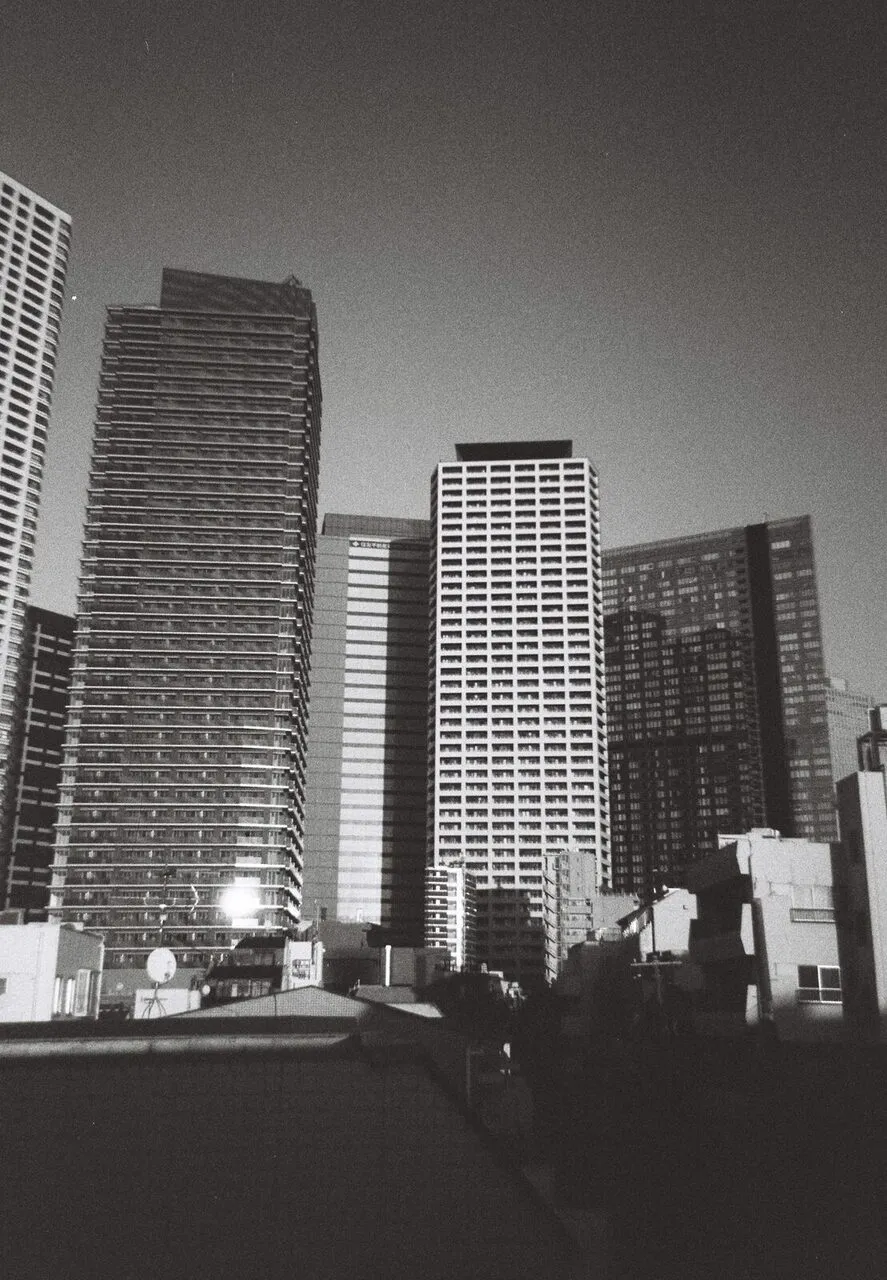
Architecture
2026
A work from 2026, composed with light, dark and form alone, without hue.